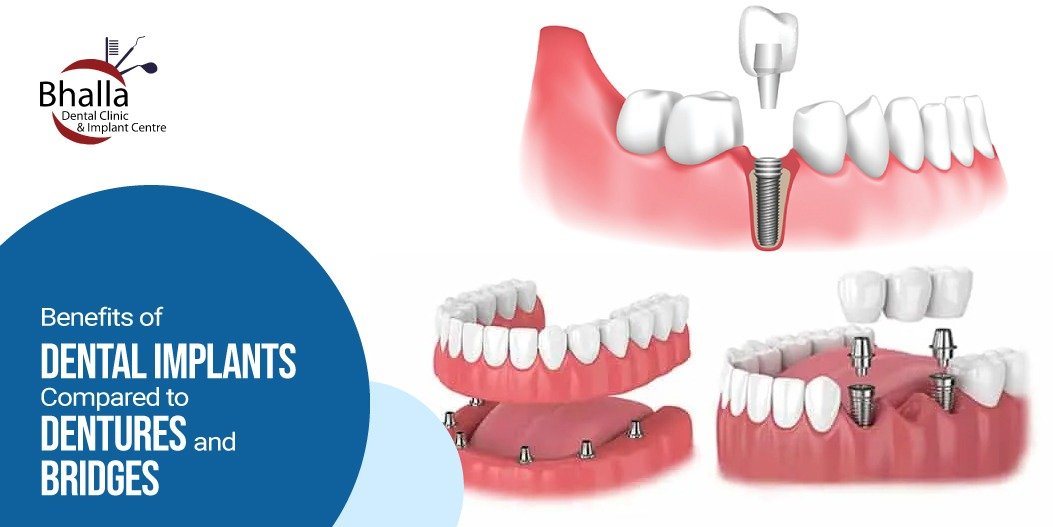
Losing a tooth is something you may be forced to confront head-on, and the effects can affect your ability to chew and speak, along with your facial structure and oral health. As dental technology has advanced, you now have several tooth replacement methods available. Dental implants in Ahmedabad are increasingly popular as a long-term alternative to traditional dentures or bridges. Patients who understand the differences between dental implants and other tooth replacement materials can begin to weigh the function, comfort, and consequences of oral health when making a decision.
In this post, we’ll tell you everything you need to know about dental implants, how they work and why they are frequently preferred over dentures and bridges.
What Are Dental Implants?
A dental implant is an artificial tooth root made of titanium (an excellent metal for conducting fusion of bone) and other biocompatible materials. They are implanted in the jaw to support an artificial tooth, bridge or even denture. Once installed, the implant anchors itself to the jawbone, a process known as osseointegration and acts as a stable support for an artificial tooth.
The dental implant system is generally composed of three constituents:
Crown: The visible portion, resembling a tooth.
Abutment: Connects the implant to the crown
Implant fixture: the part of the implant that is placed into the jawbone
If you have one or more missing teeth, dental implants may be the best solution for their replacement.
Understanding Dentures and Dental Bridges
Before we go into the benefits, let’s first understand dentures and bridges a bit.
Dentures
Dentures are removable appliances that replace missing teeth. They may be:
Complete or Full Dentures (when all of the teeth are missing)
Removable Partial Dentures (for a few missing teeth)
They rest on the gums and are supported by soft tissues surrounding them.
Dental Bridges
Dental bridges are a method of replacing one or more missing teeth by fixing false teeth to the surrounding natural teeth. The teeth next to the missing tooth will need to be filed down so that crowns can be placed on top. Those crowns will provide strength and support for the bridge.
Key Benefits of Dental Implants Compared to Dentures and Bridges
1. Improved Comfort and Oral Sensation
Dentures sit on the gum, and they may become irritating, cause sore spots or be uncomfortable for months. They may reduce the perception of taste if they cover the palate.
Dental implants:
Feel more natural
Do not press on the gums
Permit normal temperature and taste sensation
It leads to a better eating behaviour.
2. Preservation of Jawbone Health
Preventing bone loss. Perhaps the most essential aid provided through dental implants is that they help prevent bone loss. Once a tooth is lost in this manner, the part of one's jawbone where that tooth once was begins to shrink away because it is no longer being stimulated.
Implants are designed based on bone work, similar to a natural tooth root.
Denture and bridge restorations do not influence bone removal.
And as we lose bone over the years, those changes are kind of a doggone good motivator to put some implants in and not have to deal with it.
3. No Damage to Adjacent Teeth
With dental bridges, healthy adjacent teeth need to be ground down to support the prosthesis. This procedure is irreversible in natural teeth.
Dental implants:
Stand independently
Do not involve the other teeth
Help maintain overall tooth structure
That makes implants structurally less conservative.
4. Better Stability and Function
Dental implants are anchored into the bone, so, there is no need for denture adhesive. Unlike dentures, they aren't loose, and they don't move when you speak or eat. Implants require no support from other teeth, whereas bridges do.
This stability allows for:
Clearer speech
Improved chewing efficiency
Greater confidence during daily activities
5. Long-Term Durability
Well-maintained dental implants can last many years, even a lifetime. Yes, crowns may require replacement after some time, but an implant lasts a lifetime.
In comparison:
Dentures can break or need frequent repairs or replacements
Bridges, wear and tear, tooth decay, and trauma cause injury to teeth.
6. Easier Oral Hygiene Maintenance
Maintaining dental implants is more like maintaining real teeth. Its teeth are brushable and flossable.
Dentures require:
Daily removal and cleaning
Special adhesives in some cases
Bridges may also require special cleaning instruments to clean under the prosthesis.
7. Enhanced Facial Aesthetics
Dental implants help maintain the natural shape of your face and jaw by supporting the bone structure and facial structures. This shrinking bone can cause the shape of a person's face and facial appearance to look sunken or squashed.
Implants support:
Long-term facial structure
Natural smile appearance
Facial symmetry
Who May Be Suitable for Dental Implants?
Dental implants may be suggested for people who:
Are in overall good health
Lost one or more missing teeth
Maintain good oral hygiene
Sufficient jawbone density or eligible for a bone graft
Bone health, gum condition, and the patient’s medical history will be considered by a dentist before recommending implant treatment.
Dental Implant Treatment Process Overview
An implant procedure generally includes the following steps:
Clinical examination and imaging
Implant placement surgery
Healing and bone integration period
Attachment of abutment and crown
The time frame is different for each patient, depending on the healing and the treatment needed.
Conclusion
Implants have functional and structural advantages over a bridge or denture. Their capacity to maintain healthy bone structure, durability and natural ability to function in the mouth has made them an accepted tooth replacement alternative. Dentures and bridges are acceptable in some cases, but dental implants have become the treatment of choice due to their longevity and biologic benefits. It isessential to consult a dentist; you can visit Dr Bhalla Dental Clinic before choosing the best method for your oral health.
